
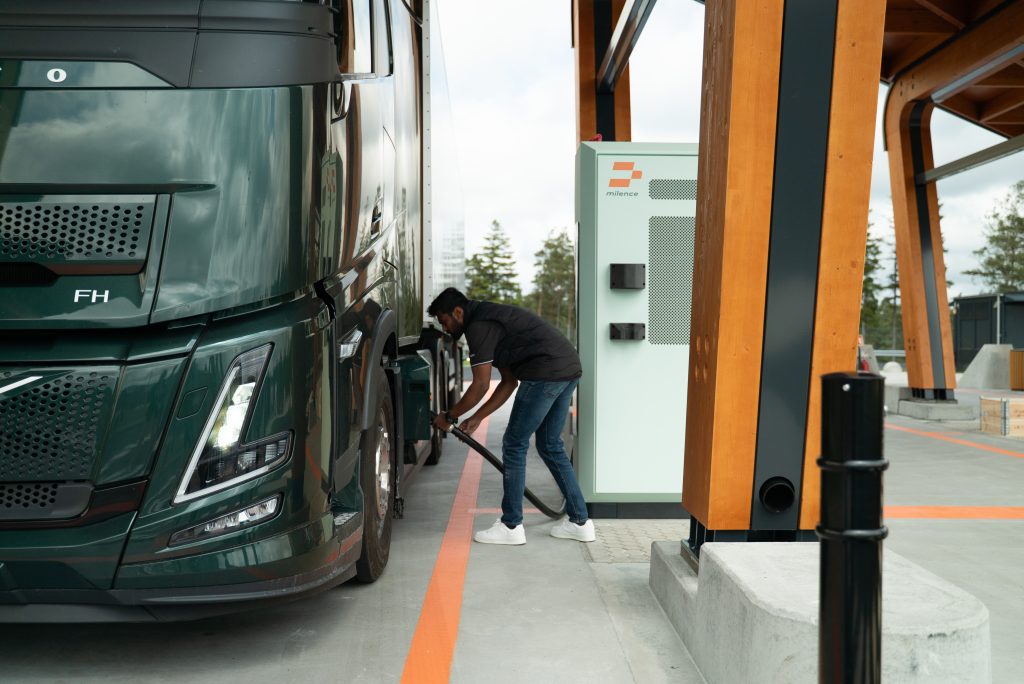
In a milestone moment for sustainable freight transport, Milence — the joint venture building Europe’s largest public charging network for electric heavy-duty vehicles — has unveiled the continent’s first publicly demonstrated Megawatt Charging System (MCS) at its expanded Landvetter hub near Gothenburg, Sweden. Conducted in partnership with Volvo Trucks, the demonstration signals the dawn of a new era in high-power electric truck charging.
The Landvetter site, now upgraded with one MCS bay and eight CCS bays, marks a crucial step toward completing Europe’s first MCS-enabled corridor. This ultra-fast charging tech enables long-haul electric trucks to power up in less than 45 minutes, finally matching the productivity demands of fossil-fuelled logistics.
The MCS demonstration, staged with a Volvo FH Aero Electric truck, underscored the system’s real-world readiness. With up to 780 kWh battery capacity and a range of 600 kilometres, Volvo’s flagship electric truck charged from 20% to 80% in just 40 minutes, crucially, within the mandated EU rest period for drivers. For fleet operators, this eliminates the trade-off between sustainability and operational efficiency.
“This is a real breakthrough in zero-emission transport,” said Roger Alm, President, Volvo Trucks. “Superfast charging and high payload capacity make this a very competitive solution.”
The demonstration also showcased seamless interoperability — a critical factor for industry adoption. “Together with Milence, we’re proving that MCS technology is not just here, it’s working — and ready to scale,” added Kristina Nilsson, SVP Charging & Infrastructure Solutions, Volvo Energy. “Partnership is the new leadership.”

Powering the Future with Megawatt Charging
MCS is engineered for the demands of heavy-duty transport, supporting up to 1,440 kW of charging power (1,500 A at 1,000 V). The solution installed at Landvetter was developed by Power Electronics and has already been deployed at Milence hubs in Zwolle (Netherlands), and the Port of Antwerp-Bruges (Belgium).
For Anja van Niersen, CEO of Milence, the rollout represents more than technical progress. “Public charging infrastructure is the key enabler for long-haul electric transport,” she said. “With four operational hubs now live in Sweden, we already cover key routes linking Stockholm, Gothenburg, and Malmö. The expansion of Landvetter brings us one step closer to establishing Europe’s first MCS-enabled corridor.”

Sweden Leading the Charge
Sweden, with over 1,000 electric long-haul trucks and more than 150 public truck chargers, stands at the forefront of Europe’s electrified freight landscape. Milence’s investment in Landvetter builds on this momentum, reinforcing Sweden’s reputation as a pioneer in sustainable transport infrastructure. The Landvetter hub doesn’t just prioritize performance — it puts driver experience front and centre. Amenities include showers, lounge areas, vending machines, free WiFi, and flexible payment options including direct terminal payments and support for multiple e-Mobility Service Providers (eMSPs). Charging is priced transparently at €0.399 per kWh (excl. VAT) for both CCS and MCS users.
Europe’s Electric Freight Corridor Takes Shape
Landvetter’s inclusion in Milence’s charging network brings the company closer to completing a 1,500-kilometre MCS corridor linking Antwerp to Stockholm — a strategic route across two major TEN-T corridors. The corridor-first rollout strategy, supported by the EU’s Alternative Fuels Infrastructure Facility (AFIF), aims to install 284 MCS points across 71 sites in 10 EU countries.
For Milence, the mission is clear: make fossil-free road freight the default, not the exception. “This is an important milestone for the entire sector,” said van Niersen. “Electric, sustainable road transport is no longer a future ambition — it’s a reality.”